
If you are interested in where the world is going, there is an analysis by World Economic Forum from the end of last year - the White Paper “New Economy Skills: Unlocking the Human Advantage”, focused fully on the future and on the professional skills that will be needed and developed up to 2030. It is based on data from global research, job postings, company surveys, and comparative analyses across regions and time periods.
In it, it is openly accepted that artificial intelligence will no longer be just a part of our life, but in fact our everyday life itself. What is now a boom in demand for skills to work with AI technologies will very quickly fall away. Many other skills will also disappear, replaced by AI and performed much faster and, supposedly, more efficiently. Purely human skills will be the competitive advantage in the age of AI, and successful will be those who can do what AI still cannot.
Creative thinking and critical reasoning, emotional regulation and resilience, moral judgment and inner ethics, curiosity and adaptation. These are the skills that will be needed and will allow technologies to be used in a meaningful way, not only mechanically. The way people think intuitively, make decisions based on inner feeling, take responsibility and risk, work under pressure and deal with uncertainty, is their advantage. Something that AI still cannot simulate.
In this way, people will be freed from routine activities and repetitive operations, and will be able to focus on important tasks and higher goals, delegating everything everyday and “small” to AI. But are we ready for this, and while we look forward and upward, do we actually stop looking at our feet and following the foundation on which we stand.
When looked at in detail, however, not everything is so “pink”.
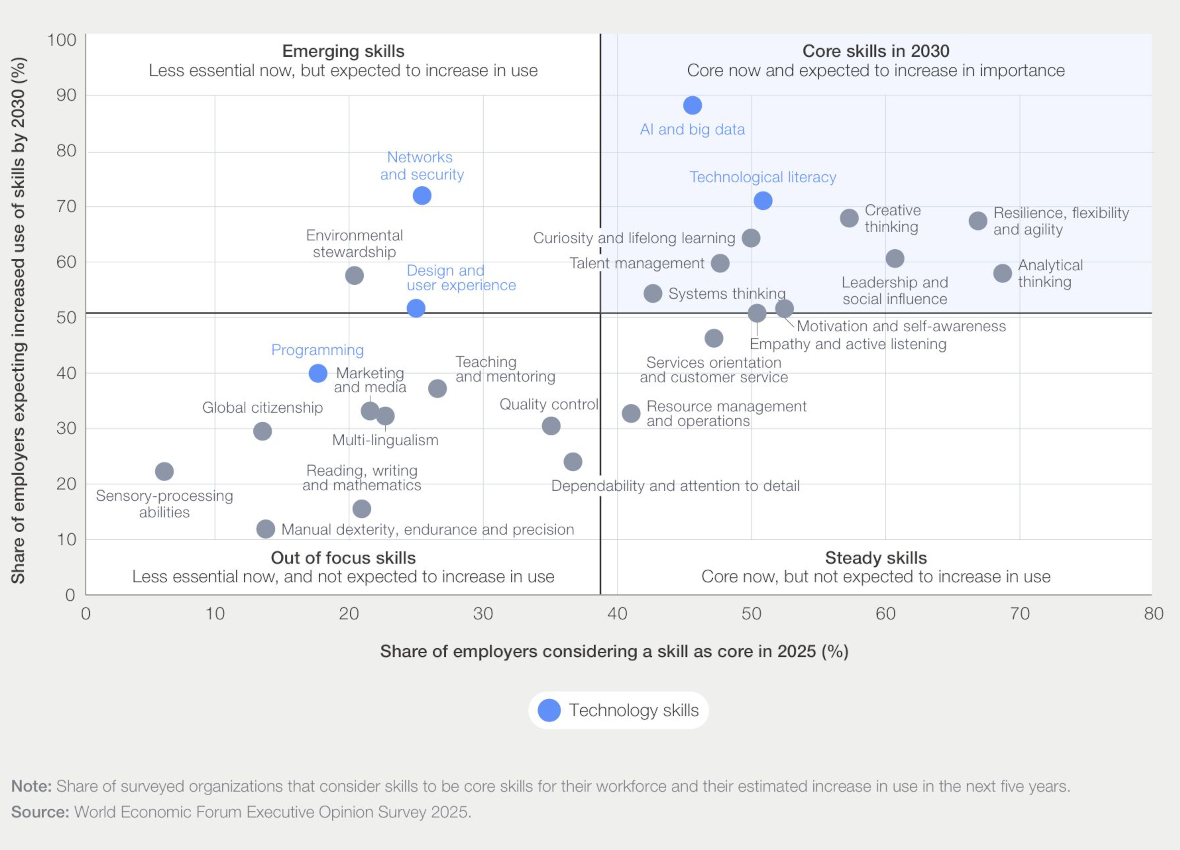
It is very worrying that basic skills such as Writing, Reading, and Mathematics are defined as Out of focus skills with 15% only. Yes, in the analysis it is said that they are seen as already present in everyone, meaning everyone should have them. Other opinions go in the same direction - “let us focus on the main skills to be developed, and take the rest as given”.
As basic skills also fall Teaching and Mentoring with about 38%. It is expected that these activities will be done by AI, but sometimes things are not only facts, words, and expressions. Models can be set, thinkers and philosophers can be simulated, but the machine passes this in the way it “understands” it. And if with technical data and formulas everything is fine, to what extent can a machine shape the character and inner world of a person in the right way. Can it teach how to form ethics and morals, personal dignity and honor?
The same applies to the skill of Attention to Details with 25%. If details cannot be distinguished and only the general picture is seen, the risk of being misled and making wrong decisions becomes very high. We do not live in an ideal or idealistic world, like the world of AI. In reality things are very different, practice often has nothing to do with theory, and the illusionary confidence that you are right is maybe the most worrying human behavior in this whole process.
Personally, I do not like this.
When you stop paying attention to a skill, it starts to decline and slowly regress. Little by little this goes “upwards” and the other skills also slow down and get damaged, so in the end they are no longer what they should be. And when this is noticed, usually it is already too late for change.
So even if all the listed skills in “Core skills in 2030” are human and cannot be replaced by AI, at the same time they start to depend on it. These skills stand on some base, which will now depend on how an AI “black box” presents the data, and what it decides is important and what is not. This can very easily mislead.
In this context, what kind of Creative thinking and Leadership are we talking about as skills, when they will happen within a frame of situations and parameters set by AI. If a person cannot check everything from bottom to top in the chain, what is what and why it is so, to understand the principles and interactions, then he cannot judge whether AI is misleading him or giving him its own assumptions.
In this way, ideas slowly become distorted, and step by step we move in a direction of development which, because it is based on wrong assumptions, starts to create a reality that confirms itself. The system feeds itself and there is no real change. It turns out that the future of society starts to be driven by decisions taken on unverified data and assumptions. Some kind of distortion appears, even if it is not intentional.
And today, in business and in society, there are many people who are not afraid to make decisions, who think supposedly creatively, who try to lead, but in fact do it wrongly, without basic knowledge. Their self-confidence is high, they are great leaders, thinkers, commentators, or experts in certain fields. But in reality they build castles in the air, where their followers live, some kind of illusionary life without foundation.
And everyone is happy and self-sufficient.
© 2026 Nikola Vasilev