
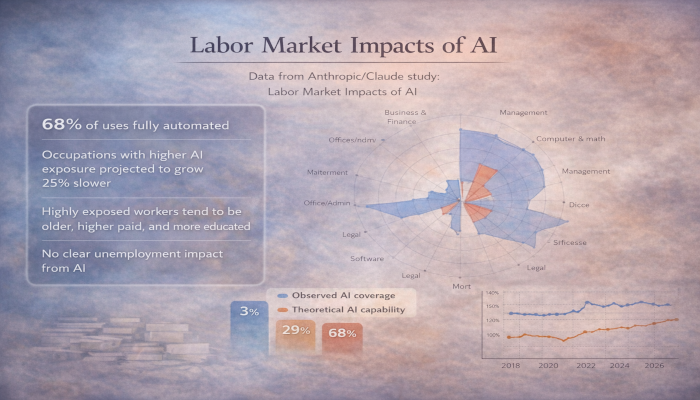
Continuing the topic about how the world is changing, during the last few days there has been a lot of talk about a new study by Anthropic (Claude AI) called “Labor Market Impacts of Artificial Intelligence.” Some people react with concern, others with excitement and applause. The study presents data in a very systematic and methodical way. It evaluates the capabilities of artificial intelligence based on statistics from how Claude is actually used in many different areas and applications.
Leaving aside the fact that this is, in a way, also a promotional presentation of their own product, there is no doubt that AI is entering almost every possible field. Sometimes where it should, and sometimes where it probably should not. The convenience of giving a task to someone else, whether a human or an artificial intelligence, while you stand aside and drink your coffee, is deeply rooted in human nature.
Some people call it organization, others creativity, and for some it is simply laziness.
But before we start worrying about our own future, or about the future of our children with questions like “What should we study now so we are not replaced?”, it is important to look more carefully at the data presented and really understand what it shows. We need to ask what, why, and how. That tells us something about the level of our society and the direction in which it is developing.
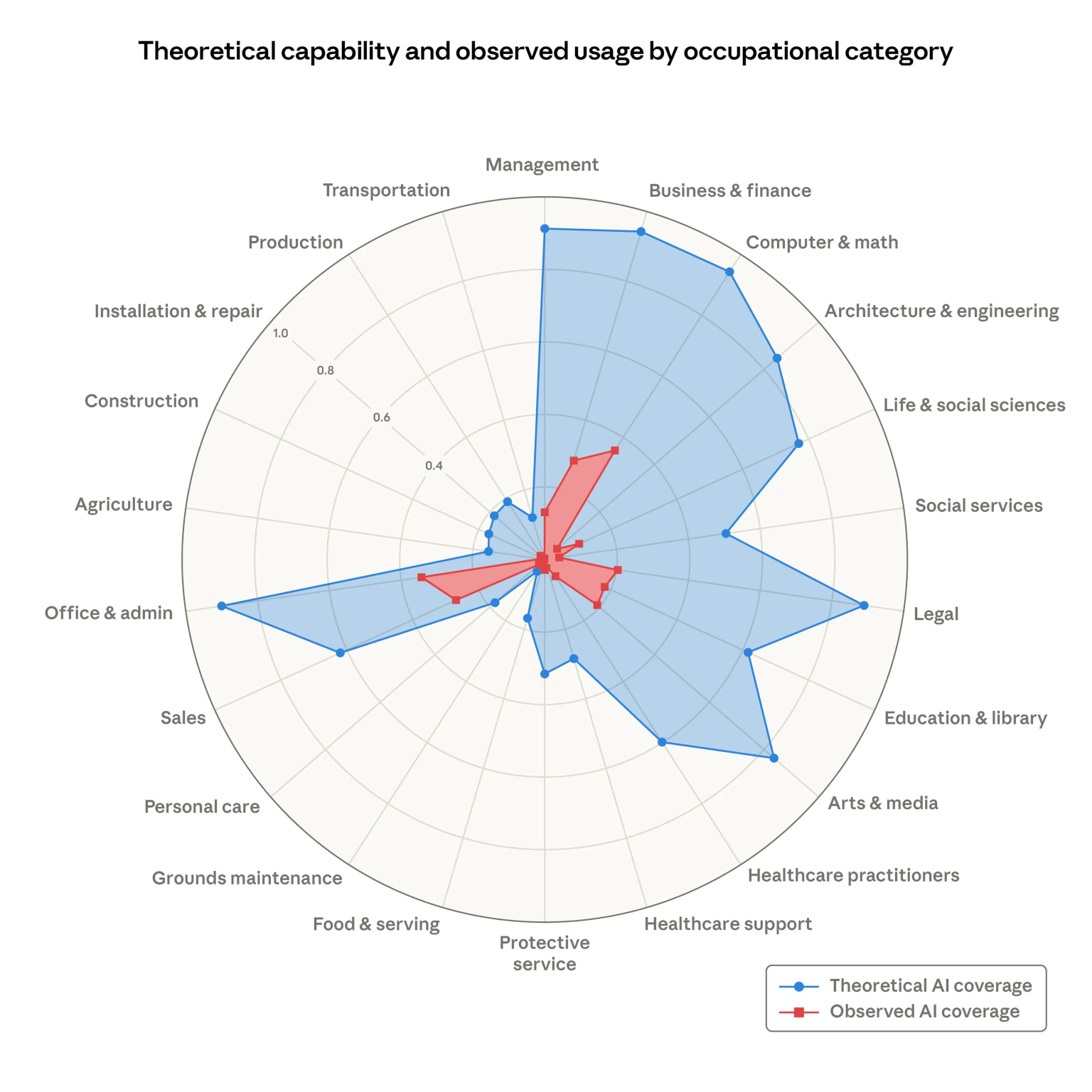
The main chart in the study shows what Anthropic believes AI is capable of doing and how much it is actually used for those tasks. The difference is large. Real usage is much smaller than the theoretical potential. The message behind the study is clear: there is a powerful tool with many abilities that are still not fully used. But it is also worth asking a different question. Why is AI not used as much as expected in the areas where it is supposed to perform best? After all, AI has already been available for several years.
On one side there is the simple explanation of human ignorance, lack of skills, or whatever else we naturally show when a new technology appears. At the same time, the modern generation often prides itself on being highly technological, learning quickly and adapting easily. On the other side there is hesitation and skepticism, which we see more often among older people. This is also part of human nature, often combined with the fear of being replaced and exposed as incompetent, which unfortunately is often the case.
But there is also a third possibility that almost nobody talks about. What if AI simply cannot handle the real essence of the work, and can only deal with the more general parts of it?
The fact that AI can replace many simple and routine tasks is wonderful and very useful. But at the same time, these tasks represent the level to which a large part of humanity has reduced its own abilities. Many people believe their work is important and complex. In reality, it is often not. It simply reflects the limits of what they can do, shaped by the general mediocrity around them. And that kind of work is very easy to replace with AI.
This situation is also supported by modern trends in the skills that employers demand. These trends often encourage a false sense of competence. People make decisions without a solid foundation of basic knowledge, relying only on ready-made facts and data. And this is exactly where AI is very strong. It can give you answers instantly, without forcing you to think. Whether those answers are correct in depth, or even true in context, may matter less and less.
Do not get me wrong. What AI can do is impressive in both scale and capability. The amount of work it can process is impossible for any single person. But no matter how much AI develops, it will always miss something essential. It will miss the divine element that humans have. The ability for creativity. The ability for asymmetric and sometimes even illogical thinking. The ability to make decisions that go against rules, patterns, and expectations. Perhaps this is exactly what drives humanity forward. Not the correct decisions, but the wrong ones. And sometimes even the mistakes.
That is why, for example, I personally am not worried about my own work, at least for now. Whether as a manager, a financial specialist, or an engineer. AI simply cannot think and act in the way my work requires. It can imitate, but it has no soul.
This is why people should learn to position themselves outside the crowd and outside average thinking. They should develop their own uniqueness, no matter what profession they choose.
And whether in the future we manage teams of ordinary people or teams of AI systems will probably not matter much.
Let the mediocre worry about that.
© 2026 Nikola Vasilev